Wednesday, November 28, 2012

A Lot to Catch Up On Part II: Italian Food Tour


October 30

I spent my last day in Italy having an unforgettable food experience. I learned just as much, and maybe even more, than I ate, which is certainly saying something. I was more stuffed than a turkey by the end of it. 

My epic food tour started at 6:50 a.m., when the company running the tour picked me up from in front of Carmella's apartment in Bologna. I didn't know exactly what I was in for. All I knew was that I had signed up for this food tour after reading rave reviews about it on Trip Advisor. I knew it would be up close and personal, and at the end of it I wouldn't be able to eat I would be so full. All this was true, and more. I had such a great time, and although it was a little pricey, it was truly a once in a lifetime experience.

To be honest, I was a little nervous about going on the tour, because I was plunging into this adventure entirely on my own. I was expecting to spend a day surrounded by retired couples who had nothing in common with me. So I was pleasantly surprised when the second group that climbed into the van was a young American couple, not much older than me. I surmised that they both had recently graduated from college. The woman was studying art in Florence, and the man was working in Africa, but he had taken a week of vacation to spend with her. It was nice to have some people around my age to talk to.

Our first stop was an hour drive away, off into the picturesque countryside of the Emilia-Romagna region. Our van and two others dropped off their passengers at a factory making Parmigiano Reggiano, the famous cheese. We eat its less glorified cousin on top of our pasta all the time: Parmesan cheese. We were met by our enthusiastic tour guide, Alessandro. 

Alessandro was the best tour guide you could ask for. He was more than a tour guide, he was a teacher. He could make a point, and really drive it home with a wacky gesture or expression, and it would stick. It's been a month since I went on the food trip, and I still remember nearly everything he told us about the making of the different food products, the certification process each of them must undergo, and his tips on how to appreciate their taste.

The cheese, freshly curdled
During the first factory tour, we watched as the factory workers, who really are artisan cheesemakers, mixed huge vats filled with fresh milk, skim milk, whey, and an enzyme from a calf's stomach. They heated the mixture and allowed it to curdle, forming a giant ball of cheese in the center. They take out this giant ball and cut it in two, producing two wheels of cheese. It was really fun to watch this process as it was happening. 

Next we visited the storage rooms, where the cheese can be stored for years. Alessandro, with the help of one of his friends from the factory, demonstrated for us how the Italian government checks the quality of the cheese: they tap on it with a hammer to see if it has any air bubbles in it. No air bubbles allows for it to receive a Grade 1 Parmigiano Reggiano certification. Grade 1 can be aged indefinitely- even for decades!  If there are some bubbles, but not too many, it gets a Grade 2 certification, which means it can't be aged forever, but it's still high quality. Finally, if it is a "cheese drum", meaning it sounds hollow on the inside of the wheel, it gets downgraded to the designation of "cheese." It's still delicious though, if not as fancy!
Alessandro and his friend, testing the quality of the cheese
Cheese Lane
Of course, after our tour of the factory, we had to tried some cheese of our own, along with some Italian sparkling wine.

Our next stop on the tour was not a factory, but someone's house. We were going to a private home, because it turns out that only private families can make the certified traditional balsamic vinegar which is sometimes called "liquid" gold. The traditional product tastes almost nothing like the balsamic vinegar you find in the grocery store, even if it does come from the same city, Modena, Italy. Alessandro explained to us the differences between factory made balsamic vinegar and the real deal. The commercial product is made form several different ingredients, and, as a result, doesn't need to age for very long. Most of the time, it includes the cooked grape must that makes up the base of the vinegar, but it also includes wine vinegar, which gives it a very sharp, acidic taste. 

On the other hand, true balsamic vinegar only has one ingredient: cooked grape must, aged for at least twelve years until it transforms into a sweet, thick vinegary substance. 

We went to the attic of the house we visited, where all of the exciting action happens. Well, at least at the molecular level. The vinegar doesn't require much work; you mostly just have to monitor it year after year. The vinegar ages in a set of six barrels called a battery. Each barrel is carved from a different wood, which infuses its flavors into the vinegar. At the beginning of the process, you put cooked grape must into each barrel. The barrels vary in size, from a large barrel like one you would find on a pirate ship, to a small barrel equivalent to maybe a small keg of beer. Each summer, a lot of the liquid in the barrels evaporates, concentrating the solution. So, each year, the family must transfer the liquid from the second smallest barrel to the smallest, the third smallest barrel to the second, and so on. At the end, they add new cooked grape must to the largest barrel. They continue this process for twelve years, and at the end they can take out one liter from the smallest barrel.

After that year, they continue to add more grape must to the barrels and to transfer the liquid from one barrel to the next, and they also continue to harvest the battery.
A series of batteries in the house's attic
There are two types of certification for traditional balsamic vinegar: minimum 12 years old and minimum 25 years old. Any vinegar produced  on or after the 12 year mark, but before the 25 year mark, is labeled as minimum 12 years of age, and any vinegar produced on or after the 25 year mark is considered minimum 25 years of age. In reality, the vinegar could be even older. All certified traditional balsamic vinegar comes in a specific type of bottle with an official seal on top. If it doesn't look like the picture below, it's not authentic!

It's amazing to think that a family could invest so much time into maybe such a small amount of a product, and as valuable as it is, they can't make a profit from it. The costs of starting a battery far exceed any economic value they might gain from it years down the line. But that really demonstrates the whole point of using these traditional methods of food making. It's not about the money, it's about carrying on tradition and producing a high-quality product to pass on to others, especially future generations. Alessandro was telling us that he has a two-year-old daughter. When she was born, he bought her a wheel of Parmigiano Reggiano to age and balsamic battery. 

After we learned about the batteries, we had a tasting. We tried some store-bought balsamic vinegar, for comparison's sake. Next we tried 6-year-old vinegar, minimum 12-year-old vinegar (which was actually 15), and minimum 25-year-old vinegar (which was actually 45 years old!). You could really taste the difference between each one. The 6-year-old vinegar was very good on its own. It was only aged in one barrel, made from cherry, and only for half the time as the traditional version, but it still was different from anything I had ever tasted. It retained a sweet, fruity taste. The minimum 12 year vinegar was very thick and complex in its flavor. You can really taste the hints of all the different woods, and it was also very sweet, sweeter than I would expect balsamic vinegar to be. Finally, the minimum 25 year vinegar was almost too intense. It was so thick that it dropped from the bottle into our spoons in large gobs. I just had the tiniest drop of it, and I was overwhelmed by all of its flavor. It was a really neat experience, but I knew that I definitely wouldn't be able to use that type of vinegar in everyday dishes. First of all, it's so expensive that I would be afraid of wasting a drop of it. Secondly, it's far too interesting and flavorful on its own to be mixed with other flavors.
Different balsamic vinegar products
Gelato with balsamic! So delicious!
We also tried some other treats which I had never even thought of eating with balsamic vinegar before: ricotta cheese with balsamic vinegar jelly, and vanilla gelato with balsamic vinegar drizzled on top. The latter was absolutely fantastic, and I need to have it again at some point. In fact, I bought a bottle of 6 year balsamic vinegar for myself because it wasn't too expensive compared to the traditional vinegar, and it was still extremely delicious.

Our next stop was a traditional prosciutto factory, where they cure pigs' hind legs. We saw many, many pigs' legs in various states of being dried and cured. It turns out that the only additive they are allowed to put on the meat is sea salt. Of course, after the tour, we tried some of the finished product. Despite the fact that I'm not a big carnivore, I thought it was delectable. 

Delicious prosciutto!

Alessandro with some pig legs
Finally, our last stop was a three-hour "light" lunch at a restaurant in Vignola, a village nearby. Dish after dish came out from the kitchen. It was all so delicious, and by the end of it I was completely stuffed. My favorite dishes were the ragu and the ravioli with balsamic vinegar sauce. Ragu, a true Bologna classic, is the real version of sauce "Bolognese", unlike the kind you find at your local Italian restaurant in the states. It's pasta with ground meat, but it was a lot less saucy and more hearty than its Americanized counterpart. Of course, we also tried more Italian sparkling wine and prosecco. We finished off the meal with a tiny espresso. 
Ragu! I was too busy eating to take a picture of the ravioli...

At the restaurant, not only did I eat an enormous amount of food, but I also had really good luck in having interesting people to talk with. I discovered that one retired couple was from Northridge, and they actually used to live in Oakland during the '80s. In fact, they had lived in the Oakmore district, which is right next to where I live. What a bizarre coincidence! We had a long, interesting discussion about how Montclair has changed since they last lived there. It was really ironic that here I was, in Italy, talking about my hometown. I also met a businesswoman from Australia, a young married couple from Hong Kong, and a couple from South Africa. It was really neat to share this unique experience with such a diverse, international group. I ended up really enjoying every aspect of the tour, and I highly recommend it if you ever happen to be in Bologna, needing something to do.

I know I sound like an advertisment at this point, but you should definitely check out their website: Italian Days


Me with lots of cheese! We had to wear ponchos for safety reasons inside the factory. Aren't they so fashionable? Not.
Me with pigs legs!

Me with Alessandro, at the end of an unforgettable day!
I hoped you enjoyed this long, educational post. I still have a lot to catch up on. Up next I will discuss my trip to London! 


Monday, November 12, 2012

A Lot to Catch Up On, Part I: Italy

It certainly has been far too long since I last posted to this blog. I have been incredibly busy with the seven classes I am taking here in Lyon. Nevertheless, I wanted to make the time to write about the incredible week-long vacation I had for All Saint's Day. I had a chance to see Italy and the UK, meet up with old friends,  pay homage to some of my favorite writers, and eat some unforgettable food. 

I wish I had more time to write about every single day, but instead I will summarize and give some of the highlights.

Friday, October 26: The first day of my break. I jetted off to Bologna, Italy to visit my oldest friend, Carmella Passero, who is currently studying abroad there. 

Saturday, October 27: Carmella and I took a day trip to Venice, which was only a two-hour train ride away from Bologna!  The city is spectacular. There was only one drawback: Venice was flooding. It's not such an uncommon occurrence there, with the city sinking on one hand and the sea-level rising on the other. The city sets up wooden platforms in some of the most crowded areas, but unfortunately in other areas we had to wade into a couple feet of water, wearing boots that were not waterproof. 
Piazza San Marco, flooded

We trudged through the city, finally making it to Piazza San Marco, which had turned into a pond. Still, we managed to see the Basilica San Marco, which had really cool elaborate mosaics on the inside. I don't know much about architecture, but I was very impressed by the interesting mix of styles in the church.

Next, we managed to find the delicious restaurant that Carmella's dad recommended to us. It was really a hole in the wall down an alley that we never would have found without his help. In Italy, they automatically put a service charge on your bill if you sit down at a restaurant, but we avoided this charge because at the place where we went you can stand at the bar and eat your food. And, boy, was it delicious! I had the Pasta Del Giorno, which was ravioli filled with ham, peas, and cheese. Carmella had their fish risotto.

After lunch, we headed to Ca'Rezzonico, an old Baroque style palazzo turned into a museum. Frankly, I enjoyed the architecture and the decoration of the building more than the art housed there. It was fun to imagine what it must have been like to live in that sort of palace, either as a family member or as a servant.

We spent most of the day traversing the city, going into to tourist shops, and gazing down at the canals. By the afternoon, all the water had receded from the streets, which made walking them much more pleasant. Although it was a gray, overcast day, we could still soak in the beauty of the city. We took the vaporetto back to the train station (which was exorbitantly expensive), and had a chance to see the Grand Canal, the Rialto Bridge, and of course, gondolas. I definitely need to go back to see the city again, when there is better weather. Still, there were so many tourists there even on a gloomy day, that I can imagine the city must be overrun by them in the summer. It's really too bad because this cultural treasure had nothing but tourists in it, and I was one of them. 


Me, on the vaporetto going up the Grand Canal

Sunday October 27 and Monday October 28: I explored the city of Bologna. Unfortunately, all of the museums are closed on these two days of the week. I mostly just wandered around the streets, passing through different neighborhoods. I saw Bologna's two main churches: Basilica San Petronius and Santo Stefano. I really liked Santo Stefano in particular because it is an interesting compilation of churches from different eras all built in one place. I felt like I was traveling through time visiting the different parts of the church. 

I also wandered through the campus of UniBo, otherwise known as the University of Bologna. It was really neat to visit, since it is considered the oldest "university"in the world. Other places have the claim of being the oldest institution of higher-learning, but Bologna can truly claim to be the oldest university because it is where the word "universitatis" was born. It was founded in 1088! That really makes UCLA look like a baby.

Bologna was very fun to visit, although it was nerve-wracking to be on my own at times, since I don't speak any Italian. They don't receive many tourists, so not too many people speak English there. Still, I appreciated being amongst locals for once, instead of just being one of an overwhelming flock of American tourists.


The city of Bologna from a balcony


I realized that just by listening to Carmella speak Italian to her apartment mates and friends that I could already understand about 25% of what she was saying. French and Italian are a lot more similar than I would have suspected. I really loved the rhythm of the Italian language, and how it sounds. I really fell in love with Italy on my trip, and I'm hoping to take Italian next quarter.

The next installment will be about my epic day-long food tour on Tuesday October 29, which warrants a whole post on its own. More pictures will be added to this post soon!


Friday, October 12, 2012

Canadian Thanksgiving in Switzerland

Last weekend, I took my first trip outside of France. I decided to visit my friend Moorea, another UCLA student who is studying abroad in Geneva, Switzerland, just a 2 hour train ride away from Lyon.

I was pretty excited about this trip because not only would it be the 10th country I have ever been to, but I would also be celebrating Thanksgiving almost two months early. 

Moorea lives in a student residence at the University of Geneva, and in her time abroad, she's made a number of international friends, including a few Canadians. It turns out that Canadians celebrate their version of Thanksgiving on the first Monday of October, which in the United States is Columbus Day (or Indigenous People's Day if you're in Berkeley). She and her friends decided to celebrate Canadian Thanksgiving by cooking a traditional Thanksgiving feast, and she invited me to join in. 

Thus, I spent all day Saturday in Moorea's kitchen having a blast and contributing to the cooking of my first Thanksgiving meal outside the U.S. We had the works: Turkey, mashed potatoes, stuffing, and gravy. Somehow Moorea and her friends miraculously found two frozen turkeys in a grocery store in Switzerland, the only two turkeys that were available in the entire country, it seemed. Moorea wanted to make cranberry sauce, but cranberries aren't really available in Europe, so we made do with these similar berries called groseille. I'm still not sure what their name is in English.

Moorea and I also contributed our own traditionally American Thanksgiving dishes, which apparently the Canadians don't usually eat: sweet potatoes and marshmallows, and macaroni and cheese (which I made with Swiss cheese and Gruyere).


 It was really fun to see her European friend's reactions to our food. For the most part, they seemed to like it, since we had no food left over after the meal. At the same time, they seemed pretty puzzled by the fact that we had marshmallows in a dinner dish. They were convince that it should be a dessert. Also, one of Moorea's friends, an Irish guy, had never had mac 'n cheese before, so I got to introduce him to it.

Along with our feast, we had a blind wine tasting competition. Each person brought a bottle of wine, and we put foil over the labels. Then we tasted each wine, rating them for which one was the best and trying to guess which country they were from. There were bottles from Spain, Italy, Australia, Chile, and, of course, France.


Wine tasting before dinner


I must admit, I had no luck guessing which country the wine was from, but I still enjoyed the tasting.

That night, I had so much fun hanging out with Moorea and her friends, especially because it was a great opportunity for me to speak French. Some of her friends were from Belgium and France and since they didn't speak very much English, we were forced to converse in French. I really enjoyed that experience, because just being around them for a few hours really improved my conversational French. I picked up on a lot of colloquial phrases and words that you never learn in school, like "truc", which means "thing" or "stuff" and is pretty much applicable to any situation.

I also learned a cultural difference between French speaking countries. In France, Belgium, and Switzerland, friends greet each other with "la bise", which consists of leaning in touching the other person's cheek with your face and kissing the air. In France, we "faire la bise" twice, once on each cheek. I learned quickly in Switzerland, you do it three times. And it turns out in Belgium, you only do it once, on one cheek. 

Other than a few small cultural differences like that one, Geneva didn't seem that different from any part of France I've visited. That's probably because it's a French speaking city. Other parts of Switzerland, where they speak Swiss German or Italian may be much different.


My second day in Geneva, I walked all over the city, trying to absorb as much of it's environment I could in my short few hours there. Moorea and I took a tram over to the UN headquarters, and saw them from outside the gate. Then we checked out the Jet d'Eau of Geneva, a giant fountain on the lake that spews water  up 140 m, or 459 feet. We hiked all the way to the confluence of the Rhône river and Arve river (yes, the same Rhône river that runs through Lyon, it starts out in the Alps). Then we walked around Old Geneva. Before I knew it, it was time for me to get back on a train for Lyon. 
The confluence of the Arve and Rhône

I had a really unforgettable time in Geneva. Even though I didn't get to see too much of the city, I had a truly unique experience that you can't get at a museum or on a tour bus. It's those moments, not the touristy ones, although those are fun, that make studying abroad so amazing.

Geneva with, the Jet d'Eau in the distance


Sunday, September 30, 2012

Adventures Around Lyon (and France) Part 2

I've had a lot of adventures in the past month. (Month? Have I really been in France for over a month now? I can hardly believe it.) I can't go into the details for each one, so I'm going to display some of the highlights.

Sept 9: Le Défilé de la Biennale de la Danse


Every other year, Lyon has a huge dance festival, kicked off by a parade. We went to see the parade as dancers marched through downtown Lyon. It was really crowded, but fun to see the dances and costumes. 


Sept 10: The neighbor who lives across the street from me also provides housing for international students. She invited us, her current lodgers, and former students who have lived with her to a crêpe-making party. It was truly a cross-cultural experience I will never forget. There were students from France, the U.S., China, Japan, Italy, Switzerland, Germany, and Peru all eating dinner together.

September 15-16: Les Journées des Patrimoine


The next weekend, Lyon celebrated its heritage by allowing the public to visit all of its museums and cultural sites for free.  On Saturday, My housemate Huong and I visited the stylish opera house, the sumptuous state rooms of Hôtel de Ville, the City Hall, and la Musée des Beaux Arts. On Sunday, we visited a small island on the Saône, Île Barbe, which had a medieval church. 


September 22-23: Annecy

This trip should warrant a whole blog post of its own, so I will explain it in some detail. We visited Annecy, which is a town in the Alps, next to Lake Annecy. It's only a 2 hour train ride away from Lyon. Annecy has such a beautiful landscape of mountains framing it, and the town itself is charming. It's canals and bright, old-style buildings reminded me of pictures I have seen of Venice. But what made it better than Venice was how clear the water was. Lake Annecy is one of the cleanest lakes in France.


The first day, after we missed our train at 8:40 a.m., we discovered two things: 1. French trains leave earlier than the time listed on the ticket and 2. You can use your tickets for the next train, as long as it's during the same general time period. 


We made it to Annecy by noon, because we took the next train there. We headed towards the cheateau, which has been converted into a museum. I believe it used to house the Ducs of Génève from the House of Savoie. The exhibits in the museum ranged from interesting to odd. Honestly, I appreciated the architecture of the building and its atmosphere more than the art it housed. 


After the chateau, we wandered the city for several hours. We saw Annecy's famous Palais d' Île, which used to be a prison. That night, we had a fancy dinner at one of the cheaper restaurants in Annecy. 


The second day, we mostly relaxed by the lakeside, enjoying the view of the mountains. We perused for food at the local market, and then had a picnic in the grass by the lake. That afternoon, I went on a one-hour boat tour around the lake. The tour, which was given in French and English, pointed out the highlights of the lake area, explaining the history and geography of the neighboring villages and mountains. I saw so many chateaus scattered around the lakeside. The aristocracy clearly loved this area, and I can see why. It's gorgeous, calm, and peaceful. 


A chateau by the lakeside which I saw on the boat tour

View from the Chateau at Annecy

Sept 29: Beaujolais

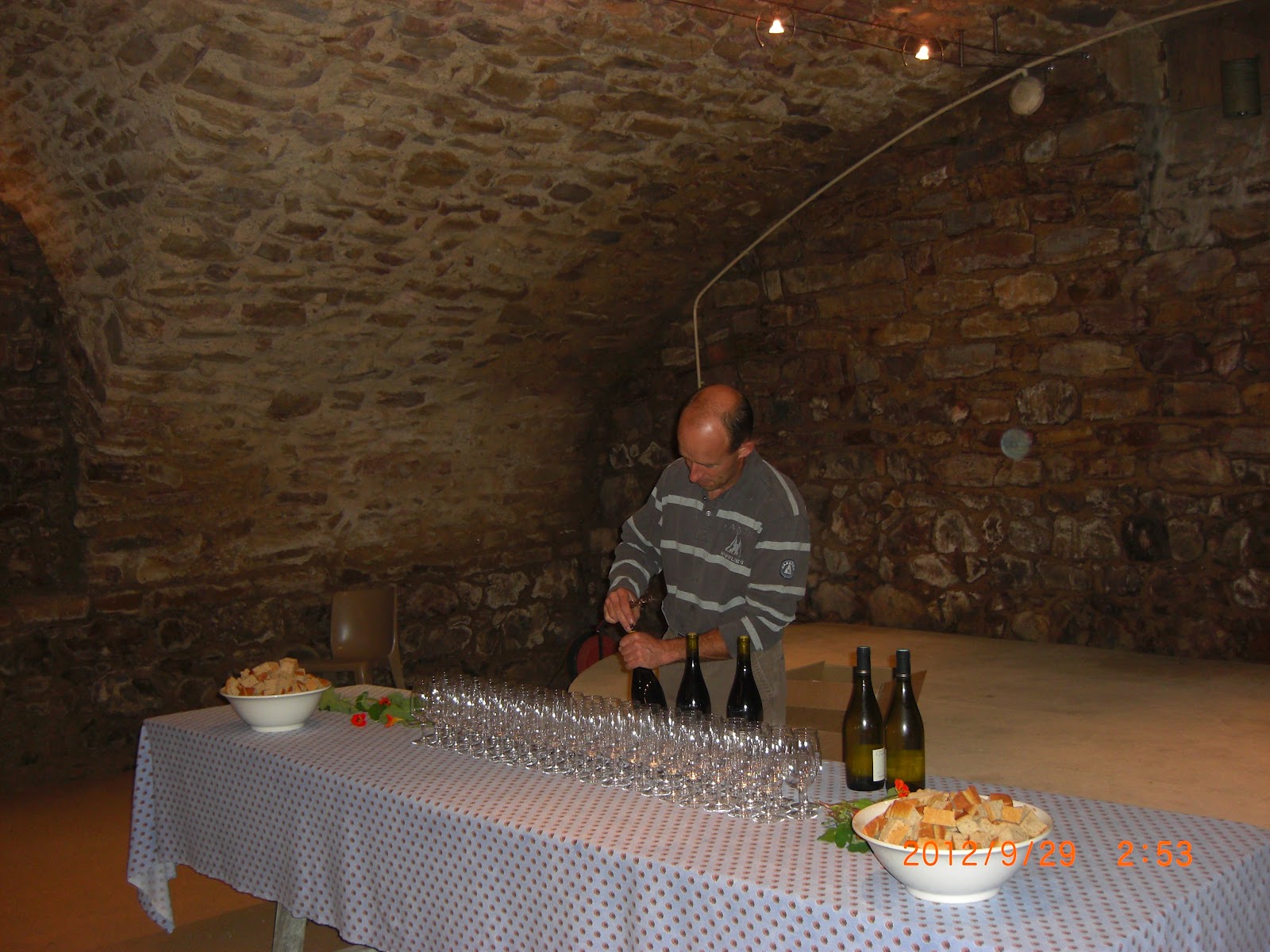
Saturday, I went to a winery in Beaujolais on a trip organized by EAP. We visited a farm owned by a French couple, who make wine and bread for a living. They were so kind and welcoming to us. As soon as we arrived, the husband explained to us how to engage our senses in order to appreciate wine and offered us some of their own wine.


 Next they served us a grand meal, which was probably the best meal I've had in France. Our first course was a salad with terrine, which is similar to a pâté. For the main course we had slow-roasted pork in a mustard sauce, served with potatoes. This was so incredibly delicious. The couple explained to us that they had cooked the pork in the oven for 10 hours! They also told us that all of the food came from local farms, and were local specialties. With dinner, they also served us more wine. Even better, they are an organic winery, which tickled my environmental conscience. Then came the cheese plate, followed by three types of pastries for dessert: a sweet bread, a cookie-like flaky pastry with chocolate chips, and finally  sugar cookies. We topped off our two and half hour with a tiny cuf of expresso with sugar in it.

After stuffing ourselves, we took a tour of the winery. The husband explained to us the process of growing the grapes, harvesting them, and making them into wine. We also watched the wife bake many loaves a bread in their large oven. They were even kind enough to give us a loaf a break each for the road. 

I've really enjoyed the many adventures I've been having in France, but definitely the nicest part of being here is just enjoying the atmosphere, especially in places like Beaujolais and Annecy, which are surrounded by gorgeous landscapes.
The winery's sign. Biologique means organic in French.


Our welcome to the winery

Wine for sale


Loaves of bread cooked in their oven, destined for our stomachs.
Dog guarding the grapes in the vineyard


Monday, September 24, 2012

Adjusting to France and to Life

Right now I am a couple weeks behind on this blog, but I will get to everything I've seen. But I wanted to address a more serious topic than sightseeing today, one that I've had a lot of experience with lately: growing up.

Before this trip, I didn't think I had much growing up left to do, to be honest. I had already lived away from home, at college. I had already held a job and learned how to sign a lease. At home and at school I am mostly independent and (I thought) competent.

Ever since my parents dropped me off in Lyon, I have missed them, and I've missed home, but that's nothing new for me, since normally I go to college in a city that is a 7 hour drive from home.

However, here I've had to do more things for myself by myself than ever before, and on top of that, I've had to do them in a foreign language. At school, I always had at least 2 meals a day provided for me at the dining halls; here, I have to shop for groceries and cook my own food. I've never had to take care of as many bureaucratic and administrative things at home as I have had to here. It's mostly because I am an international student that I have so many official things I have to take care of, but I also think France is a more bureaucratic country than even the United States. UCLA's bureaucracy pales in comparison to the amount of paperwork and waiting in line I've had to do here.

For example, to receive my long stay visa that allows me to stay in France and visit other countries, I had to go to a specific office in Lyon with, among other things, my passport, an attestation of housing, a photocopy of the passport of the woman whose house I am living in, her electricity bill and a photocopy of it,  a passport-style photo of myself, my immunization records, and a receipt for a specific 58 euro stamp that I had to buy from the French government.

These bureaucratic nightmares have been stressing me out, yes. But what's more stressful is the holes I keep digging for myself. Somehow due to the stress of living here and speaking a different language, I have succumbed entirely to absentmindedness. In the past few weeks, I've managed to damage both my cameras, lose my French cell phone, and, worst of all, leave my credit card at a cash register.

I'm not proud of how forgetful I have been acting. It's frustrating for me, because as soon as I start feeling comfortable here, I make another mistake. But I think, if anything, I've been learning to grow up faster here than I have ever before, because I usually have to fix all my mistakes myself. My parents can help me to a certain extent, but not as much as if I were in California. For example, I had to go buy a new French phone. Then I spent a day going to three different phone stores until I got to one where they could restore my former phone number.

The most important thing I've been learning here when it comes to growing up is that, if I make a mistake, even if it's a really bad one, I can't just go into my room and try to hide from it. I have to go deal with it.

I know this post is making my trip sound a lot less perfect than it has seemed in all my other posts thus far. I thought I would add a dose of realism to this blog. But, in truth, despite all of the mishaps, I continue to walk the streets of Lyon and gaze around me, awed by the beauty and excitement of France. I am realizing what the term "culture shock" truly means. Things can seem disconcerting here, but I am learning to appreciate them as aspects of a different culture that I am trying to understand.

Learning to grow up doesn't just consist of depressing experiences, either. I've also learned how to navigate a foreign city, all by myself. Taking the metro everywhere has made me feel far more independent than I feel even at home or in LA, where public transportation cannot get you very far.

I'm also learning how to travel as an adult. My friends and I went to Annecy this past weekend, a charming town nestled into the Alps, next to a large lake. Making hotel room reservations and train reservations by ourselves, without help from anyone, made me feel like I'm really an adult now, since it has always been my mom who has made these plans for me.

At Annecy, I had another grown-up feeling moment, which was my favorite part of the trip. Today is my roommate Huong's birthday, so we decided to celebrate that last weekend with a nice (expensive) dinner out in Annecy. We had a two-hour long, three-course meal that culminated with singing Huong happy birthday. We even ordered wine. Just knowing that my friends and I can go out to dinner and enjoy ourselves while having good food and good wine made realize just how much I have grown up. We didn't really need to do anything fancy. The food we had was good, but not gourmet. But the company was enough, and I think realizing the value of friends over material things, especially when you are in a strange place as I am here, is really a life experience that will stay with me.

Dinner at Annecy


Sunday, September 16, 2012

Adventures Around Lyon Part 1

My last post concerned the academic life here, so now I'm going to discuss my exploration of the beautiful city of Lyon. Since coming here, I've learned a lot more about this ancient city.

Lyon has two rivers that run through it: the Rhône and the Saône, which for pronunciation reference, both rhyme with cone. At one point the Saône empties into the Rhône, creating the Confluence, and a peninsula with both rivers surrounding it. This peninsula is called the Presqu'ile. 

Two weeks ago, I took a bus tour around the city, led by a professor of architecture at Lyon 2. She told us more about the history of Lyon, pointing out which neighborhoods of the city used to belong to the working class and which to the bourgeosie. We took the bus up to the cathedral Notre Dame de Fourvière, which rests on the top of a large hill overlooking the city, on the far side of the Saône. We took plenty of pictures of the view, and we looked around the cathedral. 

The view was breathtaking. Lyon was laid out before us like a map. I actually was able to recognize some of Lyon's geographic features. I really am starting to know my way around this beautiful city.


Partial view from the top of the hill by Notre Dame de Fourvière
When we went into the cathedral, the professor told us that the French, in fact, find the building to be ugly, because it mixes too many architectural styles. I still thought the outside of the cathedral was pretty gorgeous, but I could see what she meant about the inside. It has a lot of different paintings and decorations which are all very detailed and busy. Not very easy on the eyes.


Notre Dame de  Fourvière

Next, the bus took us to Vieux Lyon, whose medieval buildings are all preserved. The professor showed us a traboule, which is a passageway between houses. Only two districts in Lyon have them: Vieux Lyon, and Croix Rousse. She explained to us that the traboules had a rich history. They were first used by merchants in the Middle Ages to carry silk without exposing it to the rain. Later, they were used during World War II to allow Jews fleeing the Nazis to find shelter. The inhabitants of the houses would shuttle them from house to house through the traboules so that they were not discovered.


A Traboule

My next adventure occurred a couple of days later. Huong and I decided to check out the Roman Theaters, which are not far from Fourvière. It was really an amazing experience to walk around such ancient theaters. They're 2000 years old, and when you sit in the seats, it transports you right back to what it must have been like to sit there, watching a spectacle unfold. The smaller theater, the Odeon, was where musical performances took place. The bigger theater has a marble floor on the stage area, which is still mostly intact.

Above the two theaters was the ruins of an old Roman street, which we also checked out. 


The large amphitheater

I guess the Romans were short like me!


We had some interesting encounters at this ancient historical site. First, an older, unkempt French man carrying a radio hailed down Huong, asking her what her ethnicity was. Then he started telling the two of us how he ran some sort of program for young adults in which they went out doing activities. It sounded like some sort of dating service. But there was something not quite right about the way he talked to us. To put it simply: he was downright creepy. He asked us our names, ages, and where we were from. Then he asked me if I wanted a boyfriend. I told him very strongly, no thank you I already have one. He kept on encouraging us to come to his programs, and we just kept on saying "Non, merci, desolée." Huong and I had started edging away from him, and we desperately looked around for some excuse to cut the conversation short. 

The sun's going down and we want to take pictures, Huong told him, which finally allowed us to escape. But not before he kissed our hands (ew!!!). We made sure to circle all the way around to the other side of the large amphitheater when we left, so we didn't run into him again.

Next, we were admiring the view from the top of the amphitheater, when we saw some sort of group forming on stage. I still have not figured out what exactly was going on. There were several young men and women on stage, dressed in togas, and there were others on stage in normal clothes. One by one, the men and women in togas were invited up to the hooded leader of the group, who knighted them with a sword and had them swear allegiance to this owl sign on a stick.
It looked like some kind of initiation into a club or a reenactment of some historic event. Huong thought they might be part of a roleplaying group. To me, it looked like some sort of Greek life ritual, but that doesn't make sense since they do not have fraternities or sororities here. 


Some sort of reenacted ceremony? Or roleplaying?
I'm already about two weeks behind in this blog, so I'm going to post this now and continue writing about my adventures more in the next post. I've finally finished the Intensive Language Program here, two whirlwind weeks of French classes that culminated in exams. This weekend is les Journées des Patrimoine, which means that all of the museums and other attractions in the city are free and open to the public. There seems to be some sort of celebration or event every week here. Last week, there was the parade to open the Biannual Dance Festival here, which is still going on right now. I'm going out to have some more adventures, and I look forward to tell all of you about them soon.

Hey the sign has the title of my blog!

Saturday, September 8, 2012

The University of Lyon 2 and Sciences Po

This past week I started the Intensive Language Program here, which consists of three classes: writing, oral, and university techniques, which varies in subject matter depending on whether we chose Letters, Human Sciences, or Political Science. I'm taking the Letters class, and I am enjoying that class the most. It's mostly a review of literary analysis, but from a French perspective. We're learning some different essay forms that they expect you to know as a university student in France.

Although these language classes are useful for improving my language skills and preparing me for real classes here at the University of Lyon 2, I'm ready for them to be over. I only have one week left of them, and then the week after next, regular university classes start. I still have no idea what those classes will be, and I won't pick until next week.

The French university system works a lot differently than in the U.S. By the time students have completed their baccalaureate degree at the end of high school, they have already chosen a subject to focus in. Thus, they come to college already part of a department. French students don't really get much of a choice of what classes to take or when their classes will be. So it doesn't matter if the department only tells them which courses are available a week before classes start. This complicates matters for international students, like me, who are trying to take classes in multiple departments. I can tell that trying to plan my schedule for the semester is going to be stressful.

It also doesn't help that the University of Lyon 2, where I am studying, has two campuses on different sides of the city. The one I've been taking classes at so far is right next to the river. The other one, Bron, is farther out, on the periphery of the city. Luckily, the house where I'm living is located between these two locations. Still, I will have to coordinate my schedule carefully to make sure I can actually make it to where I need to be at the right time.

To complicate things even more, there is also an autonomous school within Lyon 2, Institute d'Etudes Politiques, also known as Sciences Po, which is also offering classes. I'm going to try to take a combination of classes from Lyon 2 and Sciences Po, because I think it would be pretty interesting to see what french political science classes are like.

That's how the academic side of my studying abroad is going, so far. I was pretty proud of myself when I tested into level 6 out of 7 for the Intensive Language Program classes. I guess all the French I have been taking for 15 years is finally paying off. My comprehension has really improved here. Yesterday, I listened to a two-hour lecture by a Poli Sci professor on the current state of French politics, and I understood almost 100% of what he was saying. I am still struggling a lot with speaking French. I make a lot of grammatical mistakes, but I'm able to get my point across. I know I can do better if I keep practicing.

In other news, I may be signing up for an unpaid internship with a local environmental organization started by students. If I end up doing that, it will definitely force me to develop better speaking skills very quickly. Also, it would be cool to see the French perspective on environmental issues and sustainability, or what they call, "developpement durable". 

Pictures of the Lyon 2 Campus by the Rhône